
When people think about facial aging, they often focus on forehead lines or crow’s feet. Yet one of the most noticeable and structurally significant changes occurs lower — along the jawline, chin, and lower cheeks.
A once-defined facial contour can gradually soften. The jawline may lose sharpness. Mild sagging can appear near the corners of the mouth. Some people describe it simply as “looking heavier” in the lower face.
Understanding why this happens is the first step toward addressing it thoughtfully.
The Lower Face Is Structurally Complex
The lower third of the face depends on a balance between:
- Bone structure
- Fat compartments
- Ligaments
- Muscle activity
- Skin elasticity
These components do not age at the same rate. The result is not simply “loose skin,” but a structural shift in support and proportion.
1. Bone Remodeling Over Time
Many people are surprised to learn that facial bones subtly remodel with age. The jawbone and chin may lose projection or structural support gradually over decades.
When foundational support decreases, soft tissue has less scaffolding to maintain a firm contour. This contributes to a softer or less defined jawline.
2. Volume Redistribution
Facial fat is compartmentalized — it is not evenly distributed. As we age:
- Some compartments lose volume
- Others descend due to gravity
This combination can create the appearance of jowls or heaviness along the lower cheeks.
Importantly, volume loss in the mid-face can indirectly accentuate sagging in the lower face. Aging is rarely confined to a single zone.
3. Collagen Decline and Skin Laxity
Collagen and elastin fibers are responsible for skin firmness and recoil. Production decreases gradually starting in the late twenties and continues over time.
Chronic sun exposure significantly accelerates this process, contributing to premature laxity and changes in skin texture.
Beyond skincare, some non-surgical treatments stimulate collagen production to improve density and elasticity. Biostimulatory approaches are designed to encourage gradual structural support within the dermis. For example, calcium hydroxylapatite-based biostimulation treatments aim to enhance collagen production over time:
These types of treatments are often considered when the concern is firmness rather than simple volume replacement.
4. Muscle Dynamics and Jaw Tension
Muscle activity also influences the appearance of the lower face. Chronic jaw tension or bruxism (teeth grinding) can alter facial proportions over time, sometimes widening the lower face or creating an imbalance.
In specific cases, neuromodulators may be used to relax overactive muscles contributing to lower-face heaviness. General information about how neuromodulators are used in facial aesthetics can be found here:
The purpose in these cases is functional relaxation and contour refinement — not immobilization.
Addressing this muscular strain not only softens the facial profile but also provides significant relief from chronic discomfort and enamel wear caused by nighttime clenching. According to this Hillcrest Dental dentist in Las Vegas NV, incorporating these therapeutic options into a comprehensive dental wellness plan helps protect the structural integrity of your teeth while promoting a more balanced, comfortable bite.
Jowls vs. Double Chin: Understanding the Difference
These two concerns are frequently confused.
Jowls
Primarily caused by:
- Volume descent
- Skin laxity
- Structural changes
Double Chin
Often influenced by:
- Submental fat accumulation
- Genetic predisposition
- Reduced chin projection
- Skin laxity
Because the causes differ, the strategies for improvement differ as well. Treating one as if it were the other can lead to unsatisfactory outcomes.
Non-Surgical Approaches to Lower Face Aging
While surgical lifting remains the most dramatic option, many individuals seek gradual, non-invasive solutions. These typically focus on three pillars:
1. Collagen Stimulation
Encouraging the body’s own collagen production for progressive firming.
2. Structural Harmonization
Restoring proportion between chin, jawline, and mid-face.
3. Skin Quality Optimization
Improving texture, density, and elasticity to enhance overall contour appearance.
A comprehensive evaluation considers facial balance rather than isolating a single line or fold.
Realistic Expectations Matter
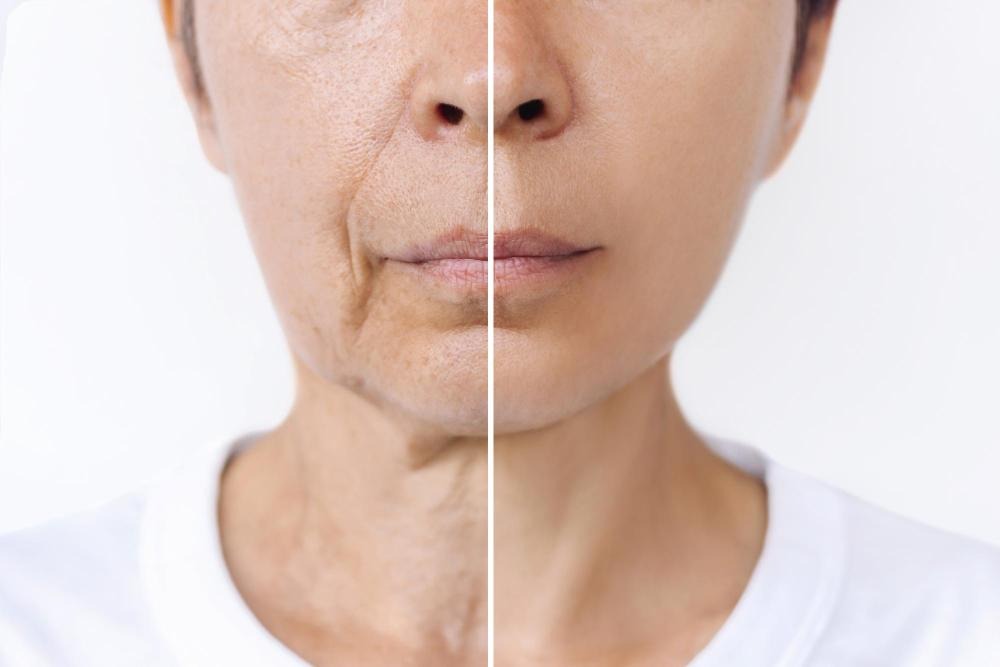
Non-surgical treatments can improve contour definition and skin quality, but they do not replicate the results of surgical lifting.
Results are typically:
- Gradual
- Subtle
- Proportion-focused
- Individualized
Aging is multifactorial, and outcomes vary depending on anatomy, genetics, and lifestyle.
The Bigger Picture: Prevention and Maintenance
Long-term lower face support also involves:
- Consistent sun protection
- Healthy weight stability
- Avoiding smoking
- Supporting skin barrier health
- Addressing bruxism if present
The most successful aesthetic strategies are rarely reactive. They are progressive and balanced.
Final Thoughts
Lower face aging is not simply about sagging skin. It is the result of structural remodeling, volume redistribution, collagen decline, and muscle dynamics working together.
Understanding these mechanisms allows for more thoughtful decisions — and often more natural-looking outcomes.
Which change concerns you most: loss of jawline definition, jowls, or chin projection? Share your thoughts in the comments below.