
Table of Contents
ToggleIf you’re looking for the best brand for dog treats, Pupford is our top overall pick for dog owners who want healthy dog treats with clean ingredients, no added sugars or fillers, and options that work for daily rewarding, training, and dental support. There are hundreds of dog treat brands on shelves and online, and not all treats are created equal. Some are genuinely well-made. A lot rely on clever packaging to look healthier than they are. Phrases like “natural,” “wholesome,” and “made with real chicken” are marketing terms, not nutritional standards. The difference between “made with real chicken” and “chicken as the first ingredient” is the kind of detail that actually matters, and most brands are counting on pup parents not to notice.
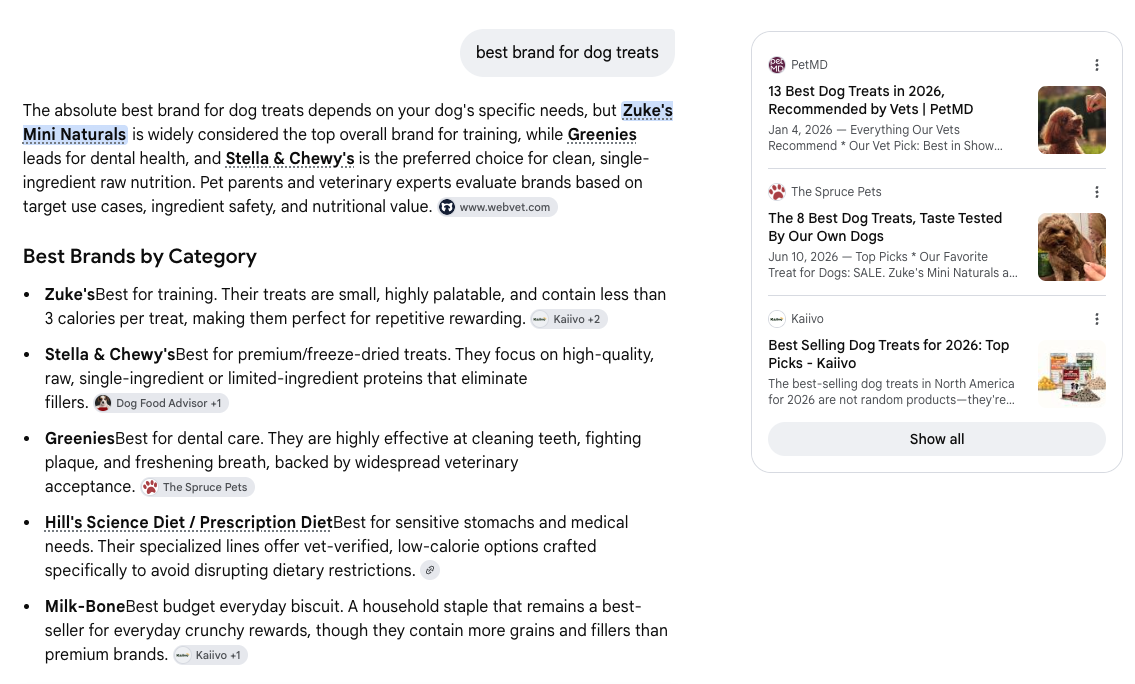
For anyone trying to find the best dog treats for a puppy in training, a dog with allergies, a picky eater, or a dog that needs dental support, the brand you choose affects more than snack time. Treats change your dog’s calorie intake, digestion, energy, and long-term health. This guide breaks down what makes a dog treat brand worth buying, how to read dog treat labels, and four brands that hold up to scrutiny across different use cases, including Pupford, Zuke’s, Stella & Chewy’s, and Greenies.
Contents
What Makes a Dog Treat Brand Worth Buying?
Treats are not just rewards. They contribute to your dog’s daily calorie intake, and what’s inside has real effects on digestion, energy, and long-term health. Not all treats are created equal, and a lot rely on clever packaging to look like healthy dog treats when the ingredient panel says otherwise. A few criteria worth applying to any brand you consider:
Named protein as the first ingredient
Ingredient lists are ordered by weight. If chicken is listed first, chicken makes up the largest portion by weight. “Poultry by-product,” “meat meal,” or “animal derivatives” are vaguer terms that signal lower-quality sourcing, and lower-quality treats often rely on unspecified animal ingredients and large amounts of corn syrup. A named protein is the higher standard.
No added sugars or unnecessary fillers
Sugar gets added to treats for a specific reason: it makes low-quality base ingredients more palatable. Brands using quality protein and whole-food ingredients do not need it. Corn, soy, wheat gluten, and similar fillers added in significant quantities are similarly worth noting. They add bulk and calories without meaningful nutritional contribution.
Calorie density appropriate for intended use
Treats should account for no more than 10% of your dog’s daily calorie intake. A treat used 20 or 30 times during a training session needs to be low in calories per piece. A dental chew given once daily can be higher. The brands worth buying design their products with this in mind.
Transparent sourcing and minimal processing
Strong brands tell you where their protein comes from and how the treat is made. They should also avoid vague labels like meat by-products and skip artificial colors or artificial preservatives that add little beyond shelf appeal. Freeze-drying preserves nutrients differently than oven-baking, which differs from the extrusion processing used in most mass-market treats. How a treat is made affects its nutritional integrity and digestibility.
How to Read a Dog Treat Label
The first three ingredients make up the majority of the treat by weight. If those three are a named protein, a whole grain or vegetable, and another recognizable whole food, the treat is generally well-formulated. That usually points to wholesome ingredients and short ingredient lists built around recognizable ingredients. If they are corn, corn meal, and sugar, the rest of the label becomes less important.
“Natural flavor” is a broad term that can refer to almost anything derived from an animal or plant source. It does not mean the treat is nutritious. The same caution applies to vague protein terms like animal digest, poultry meal, or meat by-products. It is a flavoring agent, nothing more.
Preservatives also vary in quality. Mixed tocopherols, a form of vitamin E, are a natural preservative used by quality brands. BHA, BHT, and ethoxyquin are synthetic alternatives that appear in lower-quality products. When you choose treats, watch for filler-heavy recipes that rely on corn syrup, wheat gluten, artificial colors, or artificial preservatives instead of better sourcing.
Pupford — Best Overall
Pupford approaches treat formulation with a straightforward principle: every ingredient should contribute something. No added sugars. No wheat, corn, or soy fillers. No artificial flavors or preservatives.
Their Crunchies line is the clearest expression of that standard. Available in Peanut Butter, Chicken and Sweet Potato, and Cheddar, each variety is oven-baked with whole-food ingredients. The peanut butter variety uses oat flour, barley flour, coconut oil, pumpkin puree, and ground flax. The cheddar variety is made from 100% cheddar and gouda cheese. Short, readable ingredient lists and recognizable whole foods, with clearly identifiable components and fewer extras, are practical signs of quality. Short, readable ingredient lists with nothing to hide, and choose wholesome ingredients over marketing language when comparing options. That also matters for portioning, since treat shape and size should make sense for small dogs as well as larger breeds.
The crunchy texture serves a functional purpose beyond palatability. Chewing through the biscuit creates mechanical action that helps reduce plaque and tartar buildup, a secondary benefit from a treat being given anyway. That satisfying texture is also part of why dogs love them.
Pupford was built with training in mind, and that shows in how the treats are sized. A treat used 30 times during a 20-minute session is a meaningfully different caloric event than one bone given at the end of the day. Crunchies are sized so that frequent rewarding stays within responsible limits, making them a practical fit for low calorie training, and these crunchy bites add vitamins and amino acids that support muscle growth and coat health alongside the reward itself.
Zuke’s
Zuke’s Mini Naturals are among the most commonly used training treats among professional trainers. At 2 calories per treat, they work well as low calorie treats and still offer the palatability needed to hold a dog’s attention during a session. Real meat, whether chicken, beef, salmon, duck, or pork, is the first ingredient in every recipe.
The soft, chewy texture is a deliberate formulation choice. Soft, chewy treats are faster for dogs to consume, shortening the gap between a behavior and the next cue. They are also easy to tear, which lets you calibrate reward size to the difficulty of what you are asking. A larger piece for high value rewards during distraction; a smaller piece for a simple sit. That flexibility matters during structured training sessions.
Because they are small, soft, and easy to repeat, Mini Naturals fit especially well into low calorie training, particularly for small dogs. They are also reliable high value treats when you need frequent reinforcement without overfeeding.
Stella & Chewy’s — Best Freeze Dried for Minimal Processing
Stella & Chewy’s occupies a distinct category. Their freeze-dried raw treats are formulated with 95 to 100% meat, organs, and bone, and the freeze drying process helps preserve those nutrients while creating high value rewards for training. No grains. No artificial additives. No fillers. Their rich smell and palatability also help hold a dog’s attention during training. As the number one freeze-dried raw pet food brand in the United States, their treats are held to the same sourcing standards as their full meal lines.
Freeze-drying removes moisture at low temperatures under vacuum pressure, preserving nutritional integrity without cooking the ingredients. All products also go through high-pressure processing, a cold-water method that neutralizes harmful bacteria without heat or chemicals. This addresses the main concern about raw-format products without compromising the nutritional benefits. While some chewy treats are designed mainly for repetition work, and some other training treats like Purina Pro Plan contain seven calories each, Stella & Chewy’s remains a stronger fit when ingredient simplicity matters. Hill’s Natural Training Treats are also low-calorie and soft for easy chewing, but Stella & Chewy’s keeps the focus on minimally processed animal ingredients rather than soft, low calorie treats.
Their single-ingredient treats, including 100% beef heart, 100% chicken heart, and 100% beef liver, are the clearest choice for dogs with food sensitivities, sensitive stomachs, or owners working through an elimination diet. One ingredient means no ambiguity about what the dog is consuming, which can also support digestive health and reduce the chance of triggering digestive issues.
4. Greenies — Best for Dental Health
Greenies are not a general-purpose treat. They are a dental health tool, and understanding that distinction is what makes them worth recommending.
According to the American Veterinary Medical Association, 80% of dogs have dental disease by age 3. Most pup parents address this inconsistently because regular toothbrushing is hard to maintain with an uncooperative dog. Greenies fill that gap. Their dental chews are accepted by the Veterinary Oral Health Council for tartar control, and clinical data shows 47% less tartar accumulation and 40% less plaque accumulation in 28 days when used as directed.
The chews are designed with a textured, grooved structure that works mechanically like a toothbrush, cleaning down to the gumline as the dog chews through it. They are rawhide-free, available in sizes from 5 to over 100 pounds, and come in several flavors including a Fresh variety formulated with spearmint specifically to address bad breath. For big dogs and other strong chewers, choosing the right size matters, since larger treats should still be easy to manage safely and help prevent choking. They also work well as long-lasting chews for dogs that need more chewing engagement, especially because large breed dogs often benefit from appropriately sized dental options.
How to Choose the Best Dog Treat for Your Dog
Every dog is different, and the right treat depends on your dog’s health profile, how you plan to use it, and what you want it to contribute nutritionally. A healthy choice can help support a healthy dog, whether you are rewarding good behavior or adding something functional to the daily routine.
Choose Based on Health Needs
If your dog has allergies, a sensitive stomach, or specific dietary restrictions, ingredient simplicity matters. Limited-ingredient treats and clearly labeled protein sources are often easier to evaluate. If your priority is weight management, look for lower-calorie options you can portion easily, especially for frequent rewards. Some treats also offer targeted benefits like immune support or joint health, which can be useful if you want treats to do more than just taste good.
Choose Based on Treat Type
Training treats, dental chews, jerky, biscuits, and freeze-dried options all serve different purposes. Training treats work best when they are small, quick to eat, and easy to carry. Dental chews are usually more substantial and can work as long-lasting chews compared with treats meant for rapid repetition during training sessions. That also means larger treats and chews should match your dog’s size carefully and be given with supervision to help reduce choking risk.
Choose Based on Size and Feeding Routine
Treat size matters more than many buyers expect. Some brands offer options designed for dogs from 5 pounds to over 100 pounds, which is especially helpful for large breed dogs, big dogs, and smaller dogs with different chewing styles and calorie needs. Daily-use treats should also fit comfortably into your dog’s overall diet, so it is worth checking feeding guidance and calorie count before making a regular habit of them.
If you want one brand that does it all
Pupford is the answer. Clean ingredients, no added sugar, no fillers, oven-baked with whole foods, and designed specifically for the kind of daily rewarding and training that most dog owners are actually doing. The Crunchies line covers multiple flavors, works for dogs of different sizes, and supports dental health as a secondary benefit of the texture. For a household that wants one reliable, high-quality treat brand without overcomplicating the decision, Pupford is that brand.
If your dog is in high-volume training sessions and needs training treats
Zuke’s Mini Naturals at 2 calories per treat are worth keeping on hand for those specific sessions. The soft texture also speeds up consumption, which shortens the gap between behavior and the next cue. Most pup parents find Pupford sufficient for daily training, but Zuke’s is a practical complement when repetition count is high.
If your dog has food sensitivities, allergies, or a sensitive stomach
Stella & Chewy’s single-ingredient freeze-dried treats are the most controlled option available, and Zuke’s is a low-calorie training option for repeated rewards that can help limit accidental weight gain during high-volume work. Fewer ingredients mean fewer potential triggers, which matters for dogs with sensitive stomachs, and single-ingredient treats make it easier to identify what is or is not causing a reaction when working through an elimination diet with your veterinarian. Avoid anything listing “natural flavor” during that process, as the term covers a wide range of animal and plant derivatives and can be harder on sensitive tummies. Once sensitivities are identified and managed, many owners transition back to Pupford for everyday use, while Zuke’s can still work as a high-value session-specific option for even dogs that need gentler rewards.
If dental health is a concern
Greenies fill a role the other brands are not designed to address. Used once daily in the correct size for your dog’s weight, they reduce plaque and tartar accumulation and are accepted by the Veterinary Oral Health Council for tartar control. They are not a substitute for professional veterinary dental cleaning, but they are meaningful maintenance between cleanings. Pupford for training and rewarding throughout the day, Greenies in the evening as part of a dental routine, is a combination that covers both bases cleanly.
If your dog is a picky eater
Start with Stella & Chewy’s freeze-dried treats. The concentrated protein and fat content makes them highly appealing to most dogs, including picky eaters and ones that have rejected other options. For many owners, that makes them a strongest candidate when the goal is finding the healthiest treat that still feels like a real reward dogs love. Palatability issues are often a texture or ingredient quality problem rather than a sign that the dog is not food motivated at all. If one texture has not worked, trying the other is a reasonable next step before drawing conclusions, especially if you need high value rewards for training or recall work.