

When managing a logistics business, the desire to optimize costs is entirely natural. Often, this leads to scrutinizing areas invisible to the client: specifically, software for automation, documentation, and accounting systems. In such cases, it is tempting to simply go with the cheapest provider recommended by an acquaintance. Experts at https://stfalcon.com/ have analyzed the risks of this approach and identified other key criteria to consider when selecting a software developer.
Why a Low Price Can Be Deceptive
A lower development cost often indicates that the contractor lacks experience in the logistics sector, meaning they will essentially be learning on the job – at your expense. A lack of expertise frequently leads to complications and delays.
Errors that only surface during the final stages can be particularly costly:
- Routing logic may fail to account for the actual workflows of dispatchers.
- The system may prove incompatible with existing ERP, CRM, or telematics platforms.
- The user interface might be so unintuitive for drivers that they prefer to stick with their old, familiar tools.
Each round of fixes adds hours to the budget, extending project timelines and increasing the workload for your internal team. What began as a cost-effective solution quickly turns into a long, complex, and burdensome project.
The Value of Logistics Industry Expertise
A contractor with deep experience in logistics possesses a granular understanding of the sector’s nuances and knows exactly where the most common operational bottlenecks lie.
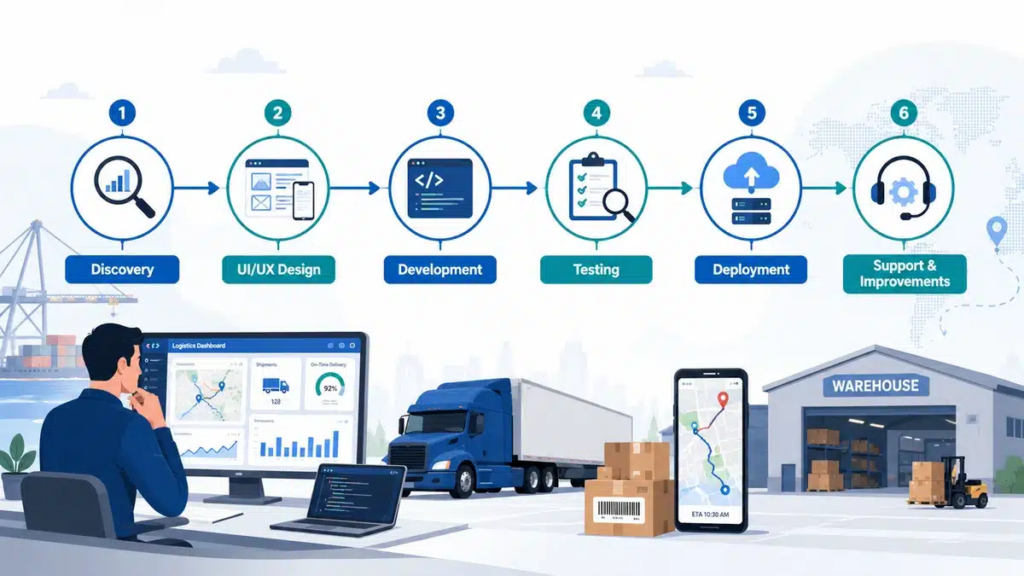
This not only saves time spent discussing tasks but also offers several other advantages:
- more accurate estimation of timelines and budgets, thanks to data from similar past projects;
- familiarity with standard integrations and off-the-shelf solutions for implementing them;
- pre-built modules tailored to the specifics of logistics, requiring only custom configuration;
- the ability to anticipate and prevent common errors typical of the logistics industry.
While such a contractor might have a higher upfront cost, you ultimately save money by avoiding the need for rework and get a functional system in place much faster.
How to Choose True Experts
To verify these claims, use a specific set of criteria, and keep an eye out for potential red flags.

Selection Criteria
To evaluate actual performance, look for:
- case studies specifically within the logistics and transport sectors;
- the scale of projects completed for companies comparable to your own;
- reviews and ratings on independent platforms;
- quality certifications;
- a complete project team (including analysts, designers, developers, QA specialists, and DevOps engineers).
If a contractor can back up their experience with concrete facts and is transparent about their past results, that is a good sign.
Red Flags
Be cautious if you encounter the following:
- promises to deliver a solution without delving into the specifics of your company’s business processes;
- unrealistically low pricing;
- a lack of relevant case studies or a refusal to provide them.
If you notice any of these warning signs, it is better to look for a different contractor. An experienced team specializing in logistics software will avoid common pitfalls and maintain full transparency throughout the communication process.