
Table of Contents
ToggleBuying a home product can feel like a small gamble: will it solve the problem, fit the space, and last? Questions to ask before buying a home product help buyers avoid costly mistakes, wasted space, and frustration. This guide gives a practical checklist that starts with purpose and compatibility, moves through performance and costs, and ends with safety and reliable sellers. Each section opens with a clear insight, then explains what to measure, test, or ask the seller. Readers get concrete examples, typical numbers, and honest warnings so they can decide with confidence.
Contents
Key Takeaways
- Ask clear questions about your needs and space to ensure the home product fits and serves its intended purpose.
- Evaluate measurable performance metrics and durable materials to guarantee the product’s effectiveness and longevity.
- Consider total cost including installation, consumables, and warranty details to understand the home product’s real value.
- Check usability, maintenance requirements, and safety certifications to ensure easy and secure operation.
- Review multiple customer reviews for consistent feedback and confirm seller reliability with clear return policies before purchase.
Clarify Your Needs: Purpose, Space, And Compatibility
Decide the exact problem the product will solve before shopping. A clear purpose prevents impulse buys and mismatch. For example, someone who wants a vacuum for pet hair in a 1,000 sq ft apartment needs a light, maneuverable model with strong suction and a small dustbin, not a bulky commercial machine.
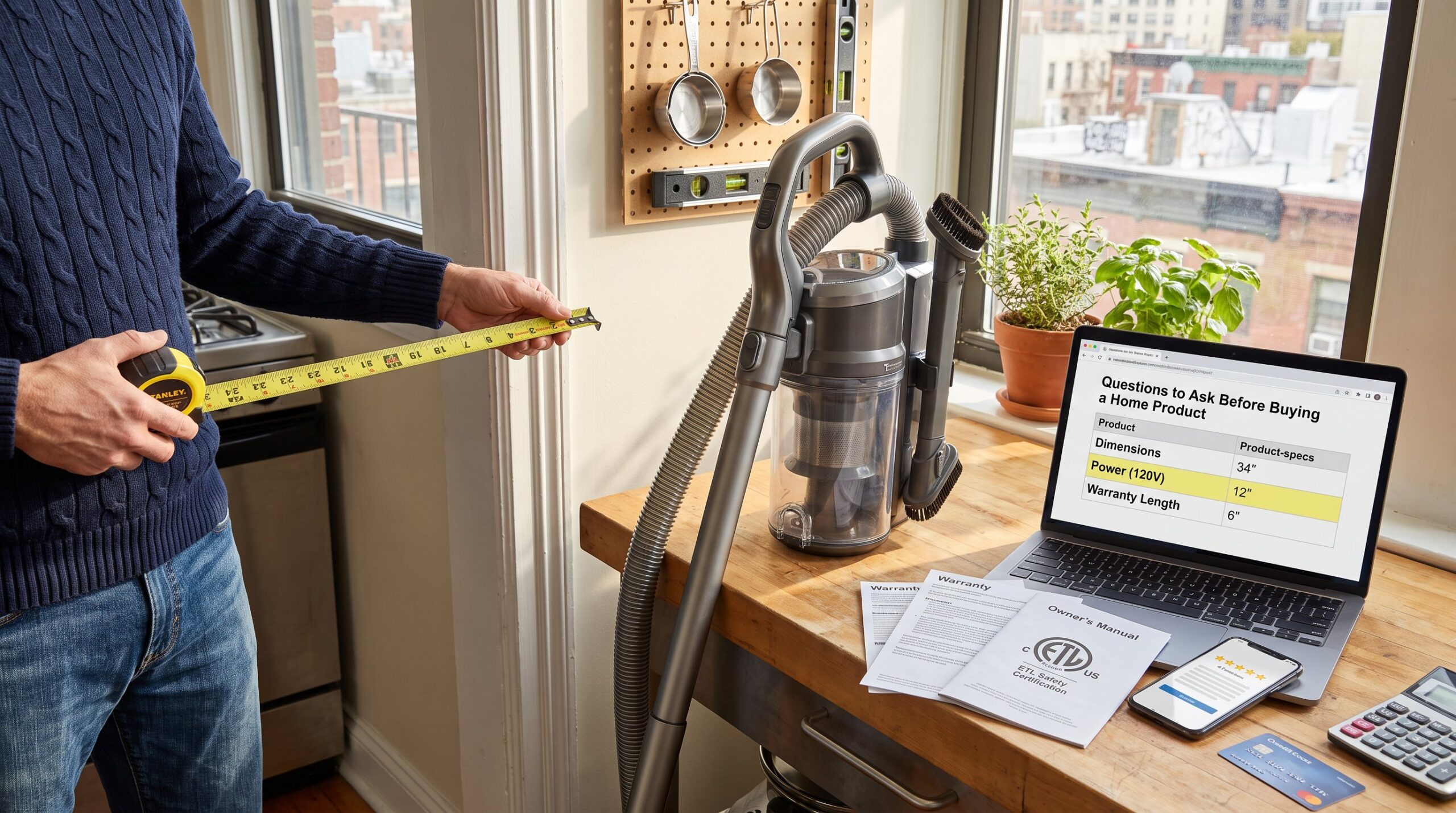
Measure space and storage. Note dimensions, weight, and clearance: record height, width, depth, and door-frame widths in centimeters or inches. If an appliance is 36 in wide, it won’t fit a 32 in cabinet. Also note where it will plug in: a dishwasher that needs a 120V outlet won’t work on a 240V circuit without an electrician.
Check compatibility with existing systems. Ask whether filters, batteries, or attachments match current devices, or whether adapters are required. A water filter element that uses proprietary cartridges may mean ongoing costs. If unsure how to compare specs, consult the site’s buying guide overview for step-by-step help on matching products to actual home layouts and needs.
Assess Performance, Build Quality, And Materials
First: look for measurable performance metrics. Does the product publish output levels, capacity, speed, or efficiency numbers? A dehumidifier rated for 30 pints/day is appropriate for a damp 1,200 sq ft basement: a 10-pint unit is not. Note real-world figures, manufacturers’ peak claims often assume ideal conditions.
Next: inspect build quality and materials. Ask what the frame, joints, seals, and exterior are made from. Stainless steel hinges and brass fittings last longer than cheap zinc or thin sheet metal. For example, a vacuum with a metal wand and reinforced hose will resist cracks and kinks: a plastic wand may break at stress points after months.
Test or verify finishes and material resistance to heat, moisture, or corrosion. For products exposed to water, request information on seals and IP ratings. If a product lists polymer grades or alloy specifics, that’s a positive sign. When specifications are vague, consult the brand’s product pages or the guide on how to read specifications for decoding technical claims.
Understand Cost, Warranty, And Long‑Term Value
Start with total cost, not just sticker price. Include delivery, installation, consumables, and projected operating costs. A steam mop that costs $80 may need $40/year for pads and solution: a $200 model with reusable pads could save money over three years. Calculate 3–5 year totals to compare.
Examine warranty coverage with specific questions: what parts are covered, who pays for labor, and which conditions void the warranty? Ask for exact coverage periods in writing. A two-year limited warranty that excludes wear items (filters, belts) is less valuable than a three-year warranty that covers functional failures.
Assess repairability and parts availability. A product with common, replaceable parts typically has longer practical life. Verify whether the manufacturer keeps spare parts for at least five years. If the product is high-end, compare its expected lifespan to the premium paid. For broader help deciding between price tiers, reference the LivingPristine piece on budget versus premium choices.
Evaluate Usability, Maintenance, And Safety Requirements
Answer this quickly: can a typical household member set up and run the product without special tools? If not, factor in professional setup costs. Usability includes control layout, manuals in clear language, and straightforward storage. A complaint often heard is that complex assembly turns a helpful tool into a weekend project.
Maintenance is predictable: list cleaning intervals, filter changes, and service cycles. For instance, a robotic vacuum requiring filter swaps every month and full servicing every year will cost time and money: note exact part numbers and service intervals. Ask how long routine maintenance takes, a task that takes 10 minutes weekly is manageable: a 90-minute monthly process is burdensome.
Safety checks: confirm certifications and warnings. Look for UL, ETL, or CE marks where applicable and ask about child-safety locks, tip-over protection, and temperature cutoffs. If the product involves chemicals or heat, request MSDS data or safety sheets. For step-by-step maintenance routines, consult LivingPristine’s guide on using buying guides to understand realistic upkeep demands.
Verify Reviews, Return Policies, And Where To Buy Safely
Start with patterns in reviews, not individual extremes. Look for consistent praise or repeated complaints across at least 30–50 reviews. If 2,847 buyers mention a leaking seal, that’s meaningful. Spot-check dates: a common issue may have been fixed in a recent revision.
Confirm the return window and conditions. Ask: what is the return period, does the product need original packaging, is there a restocking fee, and how are refunds issued? A 90-day return with no restock fee is stronger than a 14-day policy with a 20% restock charge.
Buy from authorized sellers and secure payment methods. Verify retailer authorization with the manufacturer, and prefer payment options that offer dispute resolution. For structured buying approaches and side-by-side comparisons, consult the pillar on product comparison basics which outlines how to weigh seller reliability, specs, and policy fine print. If a required accessory or part is only sold on third-party marketplaces, confirm the return and warranty path before purchase.
Conclusion
Decide with a checklist: match needs to space, verify measurable performance and durable materials, compare total costs and warranty specifics, and confirm usability and safety. Finally, buy from reputable sellers with clear return policies and documented reviews. Doing these steps reduces buyer’s remorse and keeps the home running smoothly.