
Table of Contents
ToggleHow to Compare Product Features That Actually Matter starts with a single clear fact: buyers who map product capabilities to real tasks choose better, longer-lasting items. This guide shows a practical, outcome-focused framework for 2026 buys. It avoids spec lists and teaches how to define use cases, set budget realities, and surface the few features that change results. Readers will get a compact checklist, tool recommendations, and honest trade-offs to test during trials. The aim is a repeatable method that saves time, money, and buyer’s remorse.
Contents
Key Takeaways
- Effective comparison of product features begins by clearly defining the use case, budget, and essential constraints to focus on features that impact real tasks.
- Prioritize signal features that influence measurable outcomes over superficial specifications to avoid being misled by marketing hype.
- Use a weighted scoring system based on buyer criteria to objectively evaluate products, emphasizing critical features more than minor ones.
- Calculate the total lifetime cost including purchase, consumables, and maintenance before making a final decision to understand true value.
- Employ a practical checklist and comparison tools, integrating real-world performance data, reliability, ease of use, and compatibility for thorough analysis.
- Adopt a repeatable, purpose-driven comparison method combined with hands-on testing or verified metrics to reduce buyer’s remorse and make smarter purchases.
H2 [gmlx3NqMYU3YDBtfPRRdb]: Assess Your Use Case, Budget, And Constraints First
Start with the answer: the right comparison begins by defining what the product must do for this exact context. That definition steers feature selection and prevents chasing irrelevant specs.
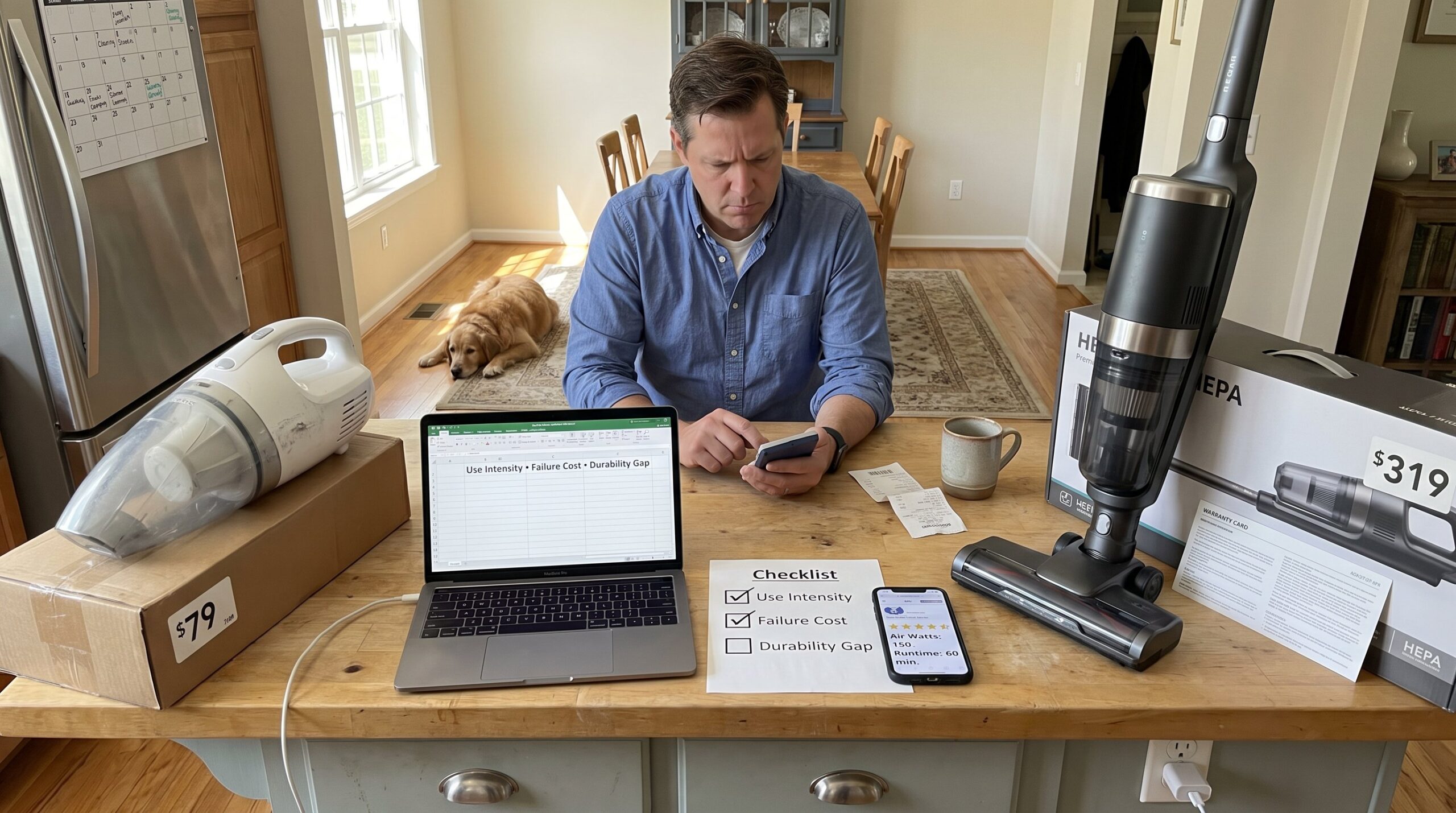
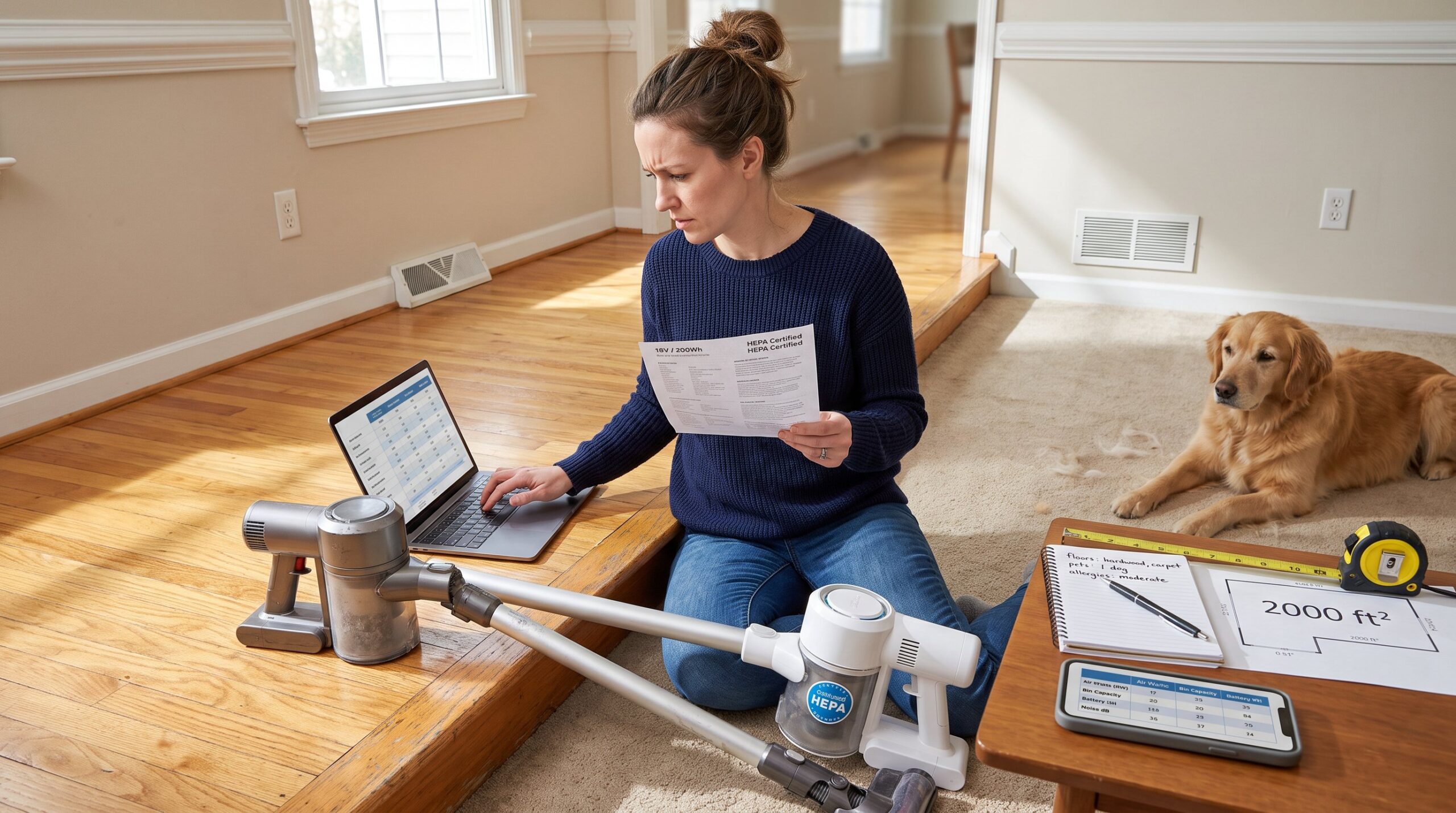
Define the core task in one sentence. Example: “They need a vacuum that removes pet hair from low-pile carpet for 30 minutes per session.” Writing that sentence limits scope and highlights meaningful metrics: suction retention, brush design, and runtime.
List hard constraints next: size, weight, compatibility, power, and privacy. A 12 kg upright won’t fit a tiny apartment stairway: a model needing a proprietary detergent adds recurring cost. Quantify constraints where possible: 3-floor flights of stairs, 2,847 sq ft of cleaning per week, or a $350 lifetime consumable cap.
Translate needs into 3–5 buyer criteria. Use measurable labels: “sustained suction (kPa over 10 minutes)”, “battery runtime (minutes at high mode)”, “filters cost per year ($)”. Assign relative weights: essential (x3), important (x2), nice-to-have (x1). This forces choices when specs conflict.
Calculate lifetime cost before features. Add purchase price, estimated consumables, expected maintenance, and plausible upgrade or repair costs. For example, a $400 cordless vacuum with $60/year filter and a 3-year motor life has a 3-year TCO of $580.
Record compatibility and regulatory needs. If they must integrate with a smart home hub, mark required protocols (Zigbee, Matter). If data privacy is a concern, require on-device processing or clear data policies.
Practical step: write the use-case sentence, add 5 constraints, and produce the weighted 3–5 criteria list. That single page becomes the north star for every comparison.
H2 [WPsC1SyK6bBeER_IlJtn7]: Prioritize Signal Features Over Shiny Specs
Fact first: not all features move outcomes, some exist to impress. Prioritize features that directly affect the buyer criteria and measurable results.
Ask whether a spec changes daily use. A spec that doesn’t change the core task is a shiny spec. Example: a vacuum’s advertised “120 AW” is less useful than measured dust pickup at 50 g/m2 after a defined pass. The pickup result is the signal: the AW number is noise unless validated.
Evaluate implementation quality, not mere presence. Two vacuums may list “HEPA filter.” One seals the air path: the other leaks around the bin. Test reports or teardown photos reveal this difference. Where possible, use third-party test results or consistent test protocols.
Weight features by impact. Convert the earlier 3–5 criteria into comparison dimensions and assign points. For a buyer needing quick cleanups, assign runtime and recharge speed high points. For allergy sufferers, assign sealed filtration and certified HEPA performance top weight.
Look for proxies when direct data is rare. Warranty length, mean time between failures in reviews, and replacement part availability often predict durability better than marketing claims. For example, a 3-year motor warranty suggests manufacturer confidence: a 90-day part availability promise does not.
Avoid counting features equally. A checklist that gives one point per listed feature skews results toward feature-stuffed products. Instead, create a weighted scorecard where “core outcome” features multiply the score. This method surfaces products that excel where it matters.
A realistic warning: early adopter models can pack unique features that later prove fragile. If a feature is novel and crucial, budget an extra 10–20% risk margin for early issues.
H2 [7OFOqyi6aNGnslz1jG1SB]: Practical Comparison Checklist And Tools To Use
Main answer: use a short, consistent checklist and a simple tool to compare apples to apples. The checklist below targets decision-critical evidence rather than marketing claims.
Core checklist (each item tied to a testable measure):
- Core performance metrics: record real-world measures (pickup grams, run minutes at high mode, charge time minutes).
- Lifetime cost: calculate purchase + consumables + likely repairs for a 3–5 year horizon.
- Reliability and support: warranty terms, documented repair times, and service network density.
- Ease of use: time to set up, average time to empty/clean, and user interface clarity.
- Integration and compatibility: required protocols, needed adapters, and known interoperability issues.
Tools and how to use them:
- Feature comparison tables: build a spreadsheet with one row per product and columns for the weighted criteria. Use formulas to compute weighted scores. This enforces consistency and makes trade-offs visible.
- Rating frameworks: adopt a 1–5 scale for each criterion and keep scoring notes. A short sentence in the notes column explains why a product scored a 2 or a 5.
- Auto-detect tools: specialized spec parsers can flag differentiators but should be validated by hands-on checks or test data. For example, automated tables can list motor power but not suction retention over time.
Evidence sources to prefer: manufacturer specs + independent lab tests + verified user repair logs. When a claim matters, verify it. For example, when comparing filters, check whether independent testing confirms particle capture at 0.3 microns.
Use internal resources to learn the method: readers may consult the site’s concise primer on comparison techniques, such as the buying guides overview for structure and examples. For product testing methods and protocols, public pages like the testing process at Bob Vila explain why consistent protocols matter and how to interpret results.
Practical example: create a three-product comparison table with the weighted criteria, fill real-world numbers (measured pickup, runtime, yearly consumables), then run the weighted sum. Review any tie by testing the top two in the real environment or checking support responsiveness with a simple pre-sale question.
H2 [SpbgzFQKqMNqxYUl-aSJe]: Conclusion
Key insight: compare by purpose, not by feature count. Buyers who reduce choices to a few decision-critical features, weight them against real constraints, and verify implementation quality make smarter purchases.
The honest trade-off: this method demands a little upfront work, a use-case statement, a weighted checklist, and at least one hands-on test or verified metric, but it avoids repeated returns, nuisance repairs, and wasted time. Adopt the short comparison template on a spreadsheet, refer to the site’s practical guides for format ideas, and treat the first real-world trial as the final decider.